Free Stock Photos: What You Can Actually Use

Most people picking a free stock photo check one thing: whether the download button works. The license underneath is where the problems live, and they only surface later, usually in an email from somebody’s legal department.
This covers the best free stock photo sites, what each license actually permits, and how AI-generated pictures change the question.
Where the free images actually are
Four stock photo sites cover almost every need. They differ more in license than in quality, but the photography on all four is good. This is not a list of twenty options, because the other sixteen are variations on these.
| Site | License | Attribution | Worth knowing |
|---|---|---|---|
| Unsplash | Own Unsplash license | Not required | Largest free library, owned by Getty, not public domain |
| Pexels | Own Pexels license | Not required | Commercial and personal use both covered |
| Pixabay | Mostly CC0 | Not required | Also covers illustrations and vectors |
| Adobe Stock free collection | Varies per file | Varies | Curated, but some files carry extra restrictions |
Start with Unsplash or Pexels when you need photos. Use Pixabay when you need vectors or illustrations alongside your photos. Treat the Adobe free collection as a place to check individual files rather than browse in bulk. All four let you search by topic, and every one of them has a license page worth reading once.
How to find images that do not look like stock
The sheer volume on the big sites is the real problem. Search for “business meeting” and you get ten thousand photos that all look like the same afternoon.
Four habits help you find images that are worth using:
- Search for the specific thing, not the concept. “Hands on a laptop keyboard” returns better photos than “productivity”.
- Go deeper into the results. Everything on the first page is already on a thousand other websites. Page four is where the usable images are.
- Look for smaller collections. Reshot leans towards candid, documentary photography, and New Old Stock curates vintage public archive material. Both are free for commercial use without attribution.
- Search in another language. The same site returns a different set of photos for a German or Spanish query than for the English one.
Most free sites now offer videos alongside photography, and the same rules apply to both.
“Free” does not mean “no rules”
Three beliefs about free stock images cause most of the trouble, and all three are wrong.
These photos are in the public domain
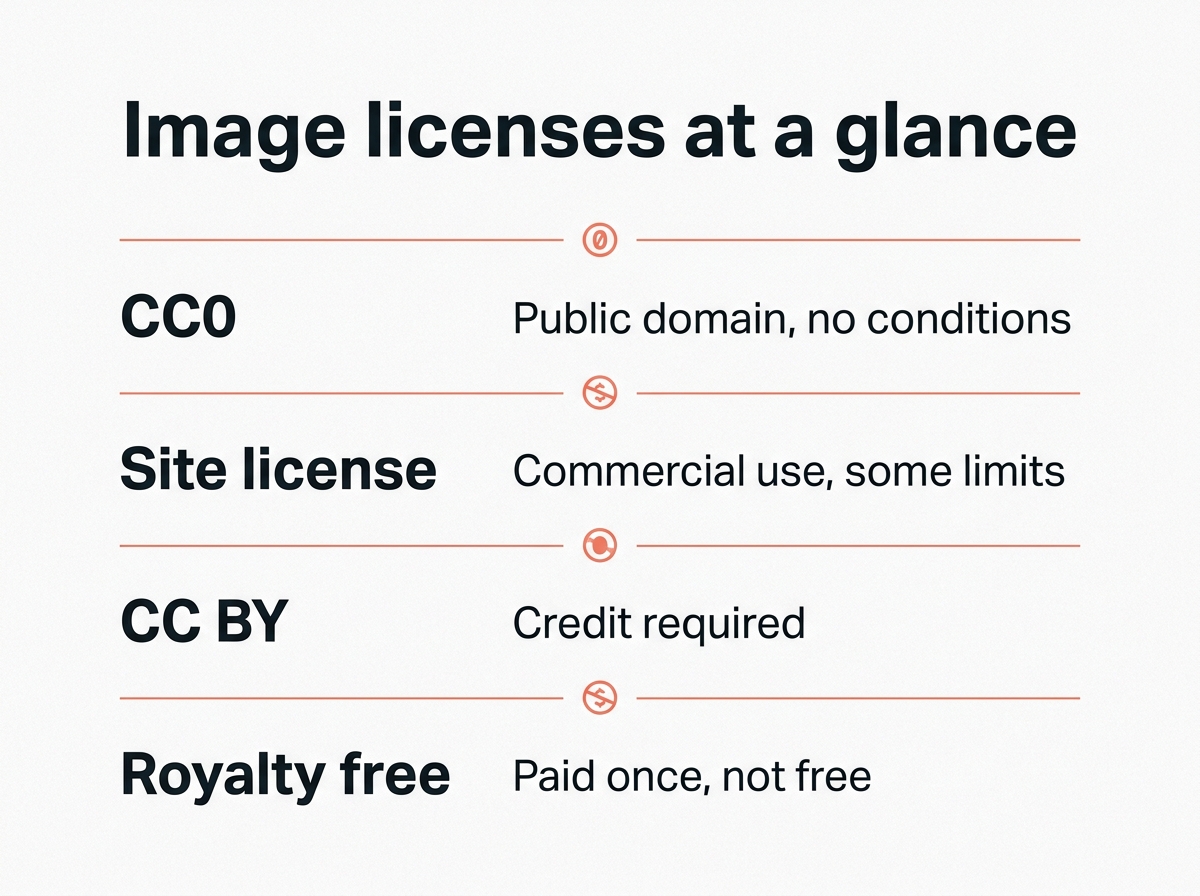
Usually not. Pixabay releases most of its images under CC0, which genuinely is a public domain dedication. Unsplash and Pexels do not. They use their own custom licenses, which grant you broad commercial use but keep restrictions the public domain would not have.
The practical difference shows up at the edges. Under the Unsplash license you cannot compile the photos into a competing stock library or resell them as stock. That is exactly the kind of clause people assume does not exist when they hear the word free.
You always have to credit the photographer
On Unsplash, Pexels and Pixabay, attribution is appreciated and not required. Crediting costs you one line and makes the photographer’s day, so there is an argument for doing it anyway, but no license forces you.
Where attribution does become mandatory is on images under a Creative Commons BY license, which you will meet on Flickr and Wikimedia Commons rather than on the big free stock sites.
Royalty free means free
Royalty free describes how you pay, not how much. It means you pay once and owe no recurring royalties for continued use. A royalty free image on a paid stock site can cost a hundred euros.
The free stock photos on Unsplash and Pexels are both royalty free and free of charge. The two properties are unrelated, and conflating them is how people end up using paid stock without paying for it.
What free licenses usually do not cover
Even the most permissive license has limits that have nothing to do with copyright in the photograph itself.
- Recognisable people. A model release governs whether a face can appear in advertising. Most free sites do not guarantee one, which makes a stock portrait risky for a commercial campaign.
- Trademarks and logos. A photo of a street full of shop signs is fine as a photo. Using it to imply those brands endorse you is not.
- Private property and artworks. Buildings, sculptures and artworks in a picture can carry their own rights, which vary by country.
- Sensitive contexts. Several licenses specifically prohibit using an image of an identifiable person in a way that is defamatory or implies something false about them.
None of this matters for a blog illustration. All of it matters for an advertisement.
AI-generated images change the question
Generated pictures remove the licensing problem of the photograph and introduce two new ones.
The first is commercial rights, and here the picture is reasonably clear. Midjourney, DALL·E and Adobe Firefly all grant commercial usage rights, though the details differ by platform and by which tier you pay for. Adobe Firefly is the most cautious option, because Adobe Stock subscribers get commercial licensing together with intellectual property indemnification, and Adobe says it compensates the contributors whose work went into training.
The second problem is less settled. Models trained on unlicensed material sit in legally uncertain territory, and that has not been resolved as of early 2026. Using those outputs commercially is a risk you are accepting rather than one somebody has cleared for you.
Can you copyright an AI image?
This is the question that surprises people who have just generated a logo.
In the United States, protection depends on human authorship, and purely machine-generated output has repeatedly failed that test. The U.S. Copyright Office publishes its registration guidance for works containing AI-generated material alongside the actual decisions, including refusals that were later upheld in court.
The practical consequence is simple. You can usually use an AI-generated image. You often cannot stop anybody else from using the same one. For a blog header that is irrelevant. For a brand identity it is a reason to commission something a human made.
How to spot an AI image in a stock library
Free stock photo sites increasingly mix generated content in with real photographs, and not all of them label it. Some now offer a filter to exclude AI images, which is the easiest fix when it exists.
Failing that, the old tells still work more often than not. Hands and teeth remain unreliable. Text in the background turns into plausible nonsense. Repeating patterns such as railings, tiles and crowds drift out of alignment. Jewellery and glasses merge into skin.
Whether this matters depends on your content. For a decorative header, a generated image is fine. But for anything presented as documentary, editorial or evidence of a real product, it is not. Readers increasingly notice, and a stock photo that is obviously synthetic undermines the text around it.
A ninety second license check
Before you publish an image you did not take, run through this:
- Where did it come from? If you cannot name the source, do not use it.
- What does the license actually say? Open it. The summary page takes thirty seconds to read.
- Does it allow commercial use? Check this even for a personal blog, because an affiliate link makes it commercial.
- Is a person recognizable? If yes, and the use is promotional, you need a model release.
- Is attribution required? If yes, add it now rather than meaning to later.
Save the license page with the file. Six months on, nobody remembers where an image came from, and that is when the questions arrive.
Getting the file ready
Stock images arrive far larger than any website needs. A download from a free stock photo site is routinely 4000 pixels wide and several megabytes, which will slow your page down noticeably. Shrinking it is the last step before the picture joins your content.
- Scale it to the width it will actually display at with the image resizer.
- Convert it to WebP with the format converter to cut the size again.
- Trim it to the composition you want using the image cropper.
All three run in your browser, so the file stays on your machine.
Quick answers
Which are the best free stock photo sites for commercial use?
Unsplash, Pexels and Pixabay all permit commercial use under their own licenses. Read the license page once and you will know what applies to every image in that collection.
Are Unsplash images really free?
Yes, they are free of charge and broadly usable commercially. It is not public domain, and you cannot resell the photos as stock or build a competing library from them.
Do I need to credit the photographer?
Not on Unsplash, Pexels or Pixabay. You do on anything under a Creative Commons BY license. Crediting anyway is good manners and costs a line.
Can I use AI-generated images commercially?
The major platforms grant commercial rights, with Adobe Firefly offering the clearest terms because it includes indemnification. The underlying legal questions about training data are not settled.
Are AI-generated images protected by copyright?
Generally not in the United States without meaningful human authorship. You can use the picture, but you have little ability to stop anyone else using an identical one.
Can I use these images for social media?
Under the main free licenses, yes, and most of them cover personal and commercial use without attribution. The limits are the same as everywhere else: no implying endorsement, and extra care with recognizable faces.
The short version
For most people, most of the time: pull your photos from Unsplash or Pexels, read the license page once, skip attribution if the site does not ask for it, and resize the file before uploading. That covers almost every image you will ever need for a blog or a landing page, and you will find more usable photos that way than by working through the list of twenty sites somebody else wrote.
Slow down in exactly two situations. When a recognizable person appears in something promotional, and when an image is going to carry a brand rather than decorate a page. Those are the cases where free stock photos and generated pictures both stop being the cheap option.